 |
||||||
 |
 |
 |
 |
|
Crustacea, the Higher TaxaJ.K. Lowry
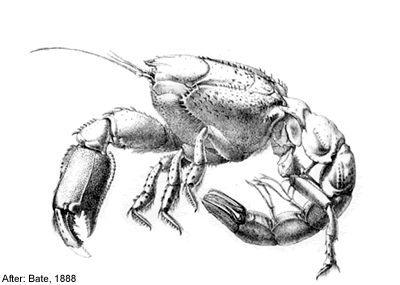
Thalassinidea (Decapoda, Eucarida, Malacostraca) Common name. Ghost Shrimps, Mud Shrimps, Sponge Shrimps. Description. Head. Rostrum present or absent; eyes stalked or absent; compound, visual elements present; ocular scale absent; naupliar eyes absent. Antennules (antenna 1) biramous; peduncle and flagellum distinct; endopod well developed; exopod well developed, whip-like. Antennae (antenna 2) biramous, or uniramous; exopod multiarticulate, or exopod forming a scaphocerite. Mandible uniramous. Maxillipeds, 3 pairs; biramous, or uniramous. Thorax. Carapace present, univalved, enclosing head and thorax, laterally compressed, smooth. Sternum divided. Thorax and abdomen differentiated. Peraeopods (legs) 5 pairs; uniramous; non-phyllopodous; differentiated (some prehensile); pylopod absent. Peraeopods 2-5 (legs) basis and ischium fused. Peraeopod 1 (leg 1) simple, or chelate, or subchelate. Peraeopod 2 (leg 2) simple, or chelate. Peraeopod 3 (leg 3) simple. Peraeopod 5 (leg 5) well developed. Abdomen with 6 somites. Epimera present. Pleopods present, 5 pairs; well developed, narrow and rounded, or reduced; pleopod 1 forming a gonopod (eg. petasma) in males, or pleopod 2 forming a gonopod (eg. appendix masculina) in males. Uropods well developed, 1 pair, positioned ventrolaterally; rami present, exopod without diaresis or exopod with diaresis, partial or complete; endopod without statocyst. Telson present (not fused to pleon). Larval development. Embryos attached to pleopods (check). Habitat. Benthic mud-dwellers. Remarks. According to Poore (1994) the only character which absolutely separates thalassinideans from other lobster groups is the row of setae along the posterior margin of peraeopod 2 (thoracopod 5) between the ischium and the propodus. Distribution. Worldwide.
Cite this publication as: Lowry, J.K. (1999 onwards). 'Crustacea, the Higher Taxa: Description, Identification, and Information Retrieval.' Version: 2 October 1999. https://crustacea.net/. |
|
 |
 |
 |
|
|
|
 |

Copyright © Australian Museum, 2021
Australian Museum website